Under contract and on a clock? Call 516-330-3870 Text Email

Inspect This Home Inspections Army Veteran Owned · NY Licensed
Nassau County · South Shore

Home inspector in Wantagh, NY

Between 2014 and 2020, Lou Rubino inspected 15 homes in Wantagh — and he did not have to travel, because Wantagh is where he lives. Post-war capes, ranches and splits make up most of the town, many of them dormered, extended or converted long after they were built.

Rated 5.0 on Google as of August 2026 · U.S. Army veteran owned · NY licence #16000039568 · 516-330-3870

The house Lou knows best is the Wantagh house

Most of Wantagh went up in the same post-war years as Levittown next door, but by many different builders — so slab, crawlspace and full basement can sit on the same street, and the first job of the inspection is establishing which one you are buying. A slab house has no basement to inspect the plumbing from, which makes the attic, the panel and every accessible hatch matter more, not less.

Seventy years on, almost none of these houses are original. Dormers, rear extensions and garage conversions are the norm, and each one is a place where new work meets old — which is exactly where Lou finds most of what goes in the report.

Related: Levitt-era slab houses next door · What an inspection costs · Schedule an inspection.
What the inspection can examine here

Photographs from Wantagh reports

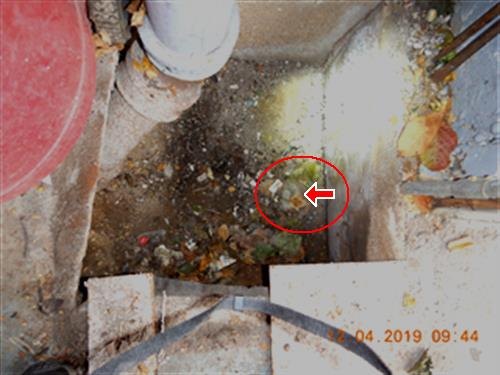
A slab floor drain with corrosion and debris circled in red on the inspection photograph.
A floor drain in a Wantagh utility room, debris ringed for the report. On a slab house this drain may be the only place the plumbing shows its age.
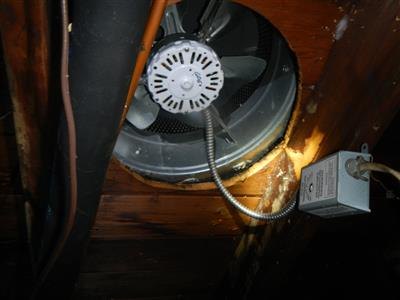
An attic exhaust fan mounted through the roof deck, with its flexible conduit and junction box.
An attic exhaust fan in a Wantagh cape. Finished attics and dormers put wiring and ventilation where the original builder never planned for them.
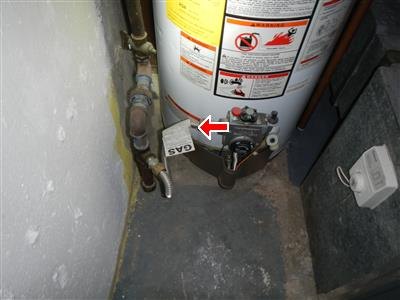
A gas water heater in a narrow utility closet, with an arrow at the gas control connection.
A water heater in a tight Wantagh utility closet — clearance, venting and the gas connection all get checked where they live.

All three photographs are from Lou's own Wantagh inspection reports, chosen because they show a building component and nothing that identifies a property or an owner.

From the Wantagh files

More of what Lou has actually photographed and flagged on Wantagh inspections. Open any note to learn what the finding means for a buyer — every link stays on this site.

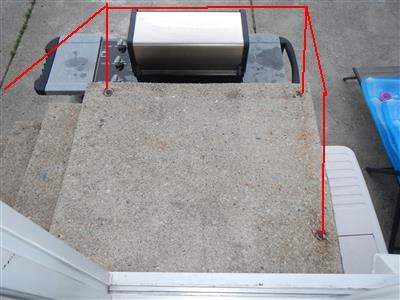
Raised concrete platform with anchor bolts at its edges and red markup lines drawn where a railing would stand
Red lines trace the outline of a missing guard railing on a raised concrete platform, anchored at the exposed bolts along its open edges. Where the drop is sufficient, a missing guard can present a fall hazard, so open edges like these are documented for assessment.
What this means: this finding

Every photograph in a report exists to make a finding checkable — the point is not the picture, it is that you and your attorney can see exactly what the inspector saw. Read a complete sample report.

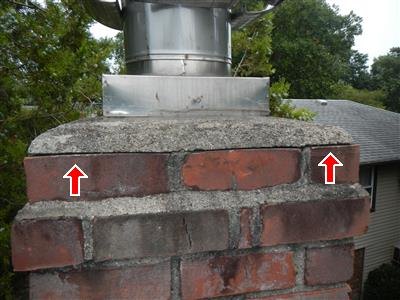
Brick chimney top with metal flue pipe and red arrows pointing at cracked mortar and concrete cap
Red arrows point to cracked, deteriorated mortar and cap material at the top of a brick chimney. Gaps here let water into the masonry, where freezing and thawing break the chimney apart over time.
What this means: the chimney

Chimney crowns, caps and screens are the cheap parts that protect the expensive parts. Cracked crowns and missing screens let water and animals into a flue, and the damage below can run for years unseen. What happens when part of a system cannot be seen.

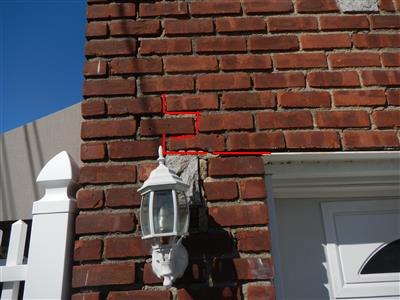
Red markup outlining a stepped crack in exterior brickwork above a garage door, next to a porch light
Red markup traces a stepped crack running through the mortar joints of an exterior brick wall. Cracks that follow a stair pattern through brickwork are something an inspector documents so their cause and movement can be evaluated.
What this means: the exterior envelope

Siding, trim, masonry and parged walls are the building's raincoat, and cracks or failed mortar can give water a way in. The report documents their location and pattern so the right contractor or specialist can evaluate them when warranted. Where water gets in, explained.

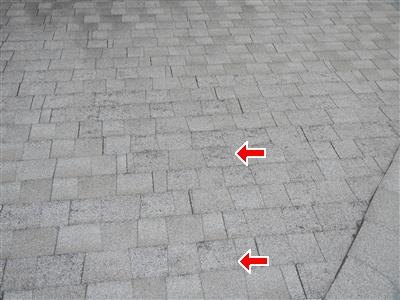
Gray asphalt shingle roof with two red arrows pointing at worn, darker patches
Red arrows mark worn areas on an asphalt shingle roof where the protective granule surface is deteriorating. Granule loss exposes the shingle underneath to the sun and shortens the roof's remaining life.
What this means: roof wear

Asphalt and slate-type roofs age in legible stages: curling, cracking, slipped pieces, exposed fasteners. Reading the stage helps establish the visible wear and whether maintenance, repair or further evaluation is the honest next step. The report must say how the roof was examined.

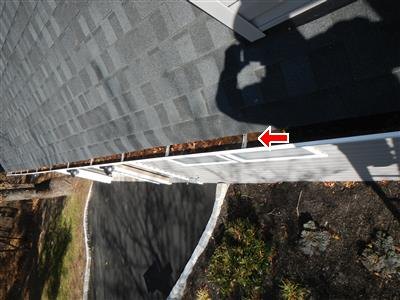
Looking down a roof edge at a rusted gutter, red arrow pointing at the corrosion
A red arrow marks rust along a metal gutter at the roof edge. A corroded gutter can leak and stop carrying roof water away from the house, which is why inspectors check gutters from above.
What this means: drainage

Managing roof runoff is often one of the most cost-effective maintenance work a house gets — discharge against the foundation raises the risk of moisture problems below. Why drainage decides basements.

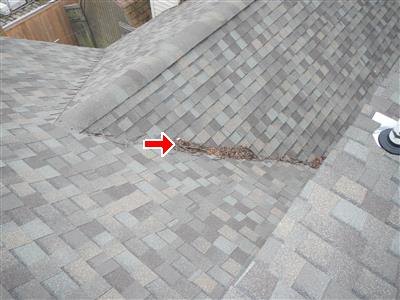
Roof valley between two shingle slopes with leaf debris collected, marked by a red arrow
A red arrow points to leaves and debris collected in a roof valley, the channel where two roof slopes meet. Debris here traps water against the shingles instead of letting it drain off the roof.
What this means: roof wear

Asphalt and slate-type roofs age in legible stages: curling, cracking, slipped pieces, exposed fasteners. Reading the stage helps establish the visible wear and whether maintenance, repair or further evaluation is the honest next step. The report must say how the roof was examined.

All photographs are from Lou's own inspection reports for jobs in this area, screened so nothing identifies a property or an owner.

Approximate town-centre locator — Wantagh in red (also Lou’s base). Not a job location, an office, or a service boundary.

Where this sits in Lou's territory

Lou covers Long Island, the five boroughs and Westchester from his base in Wantagh, and the archive behind these pages shows where that work has actually concentrated.

Also nearby: Bellmore · Massapequa · Merrick · all 26 towns.

Call Lou Text