Under contract and on a clock? Call 516-330-3870 Text Email

Inspect This Home Inspections Army Veteran Owned · NY Licensed
Old electrical · Long Island, NYC & Westchester

Federal Pacific was never recalled. That is the problem, not the reassurance.

Search the name and the first thing suggested is “recall”. There wasn’t one. The investigation was closed in 1983 without a finding, which means no manufacturer, no regulator and no insurer will ever make anybody replace one. That is exactly why they are still sitting in basements across Nassau County.

Electrical is core inspection work. Unlike mold, radon or pests, there is no separate licence and no carve-out. It is part of every home inspection Lou does, in Nassau, Suffolk, Queens, Brooklyn, Manhattan and Westchester. The estimate costs nothing. Call 516-330-3870.

Knob and tube: the wiring is not the hazard, what was done to it is

This is the part almost everybody gets backwards, and it changes what you should do about it.

How it was meant to work

Two separate conductors, held away from the framing on ceramic knobs and passed through ceramic tubes, running through open air. The air gap was the design. It let the wire shed heat, and it kept the hot and neutral physically apart.

Undisturbed, in a dry space, hundred-year-old knob and tube can still be perfectly intact. Plenty of it is.

What broke it

Insulation. Somebody blew cellulose into the attic or stuffed batts between the joists, and the conductor that was designed to breathe got buried. The heat has nowhere to go.

The National Electrical Code prohibits exactly this at 394.12: concealed knob and tube may not be used in hollow spaces of walls, ceilings or attics insulated with loose, rolled or foamed-in-place material that envelops the conductors.

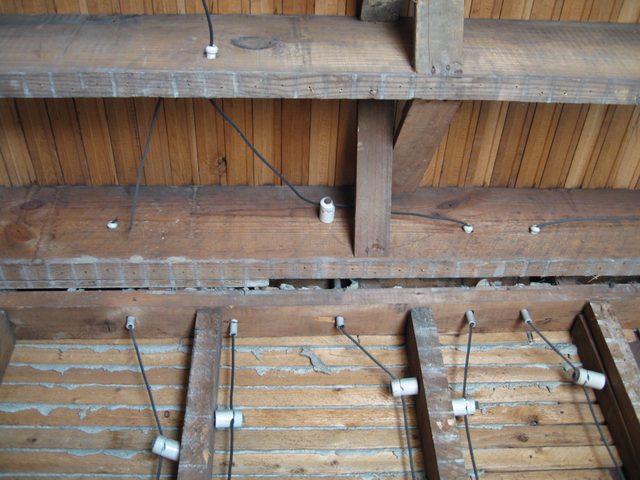
Knob and tube wiring beneath floor joists: white ceramic knobs fixed to the timber with single conductors threaded through and around them.
This is the thing itself. White ceramic knobs screwed to the joists, one conductor per knob, running through open air with a gap between the two wires. Photo: Laura Scudder, CC BY-SA 3.0, via Wikimedia Commons.
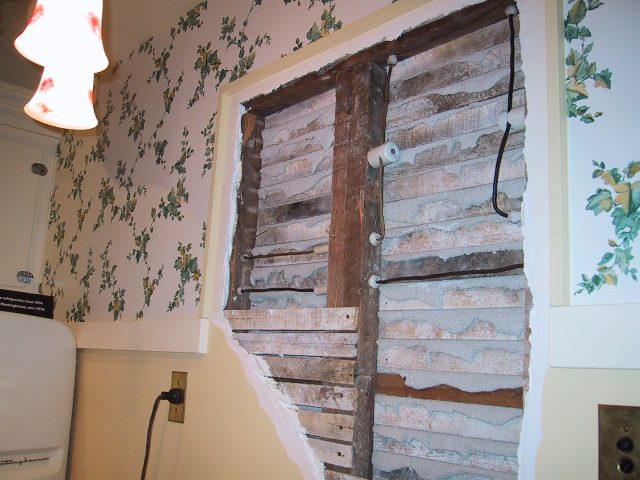
A wall opened to the lath and studs, showing ceramic knobs carrying knob and tube conductors vertically up the stud bay.
The same wiring inside a wall, with the plaster and lath opened up. This is why an inspector cannot tell you how much of it survives: normally none of this is visible. Photo: Bill Wtshymanski, public domain, via Wikimedia Commons.

Those two are reference photographs, not Lou’s. Every other photograph on this site comes from his own inspections, and the ones further down this page do too. His archive simply has no knob and tube frame in it, and borrowing two honestly beat pretending.

So the question in an attic is never just “is there knob and tube”. It is whether somebody insulated over it, and whether anybody has spliced modern cable into it in the dark.

The rest of the list

What else turns up in a pre-war basement

  • Amateur splices. Knob and tube joined to modern cable with wire nuts and no box, tucked above a ceiling where nobody looks.
  • No ground. Two-wire circuits throughout, three-prong outlets fitted anyway, so everything plugged in only looks earthed.
  • Overfusing. A 30 amp fuse protecting wire rated for 15, which defeats the one thing the fuse was there to do.
  • Brittle insulation. Rubber and cloth that has gone hard and flakes off when touched, usually worst near heat.
  • Open junction boxes. Covers missing, connections in open air.
  • Zinsco panels. Breakers that can fail to trip and bus bars that corrode where the breaker clips on.
  • Federal Pacific Stab-Lok. The one below.
  • Buried panels. Boxed into a finished wall or behind shelving, which makes them both unsafe and uninspectable.

The recall that never happened

In 1982 the Consumer Product Safety Commission began looking at reports that Federal Pacific Stab-Lok breakers were failing to trip. In 1983 it closed the investigation without a recall, saying it had insufficient data and insufficient budget to reach a conclusion.

Independent testing since has repeatedly found Stab-Lok breakers that do not trip when they should, and some that jam in the on position. Published failure rates vary a lot between studies, so anyone quoting you one precise figure is being more confident than the evidence allows.

What matters for you is simpler. A breaker exists to cut power before a wire gets hot enough to start a fire. If it does not trip, everything downstream of it is protected by nothing. And because the file was closed rather than resolved, nobody was ever compelled to fix any of it. Your insurer may still take a view even though the government did not.

Zinsco is a similar story with a different name on the door. Both are identifiable on sight by someone who has seen a few, and neither can be assessed by testing a breaker with the power on.
What actually gets looked at

A residential electrical panel photographed with the dead front cover removed, showing breakers, neutral bars and branch circuit conductors.
A panel with the dead front off. This is a modern panel, shown because it is the only way a panel is genuinely inspected: covers come off, and what is behind them is photographed.
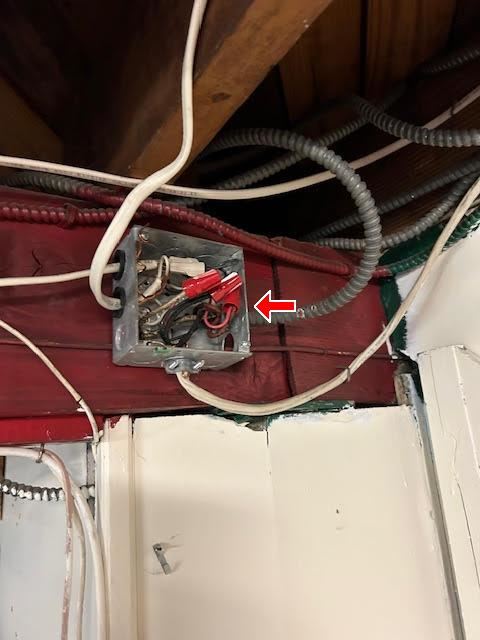
An open junction box with its cover missing, wire connectors exposed, mounted on a joist in an older basement alongside armoured cable.
A junction box left open in an older basement, cover missing and connections exposed. Small, cheap to fix, and exactly the sort of thing that is invisible if nobody goes and looks.
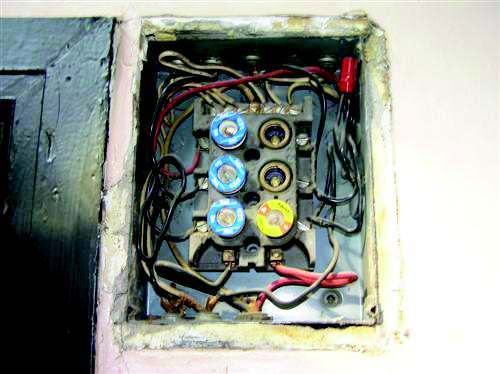
An original screw-in fuse panel recessed into a plaster wall, with three blue Edison-base fuses, empty sockets and old cloth-covered conductors.
An original screw-in fuse panel, still in service. Edison-base fuses, empty sockets and cloth-covered conductors. This is the era knob and tube belongs to.
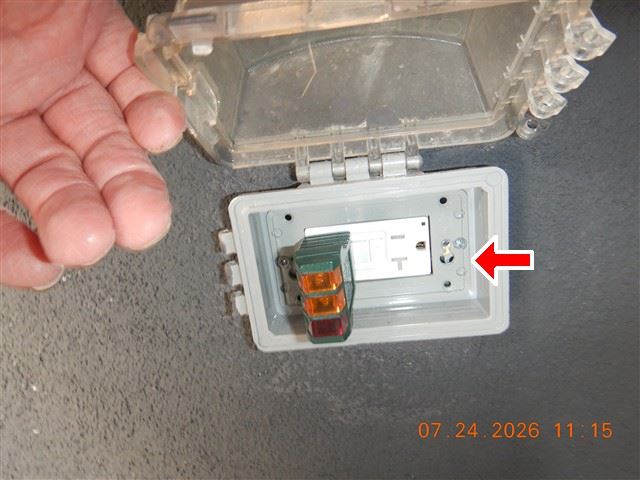
A plug-in receptacle tester held against an outlet during an inspection, its indicator lights showing the wiring condition.
A receptacle tester. Three dollars of plastic, and it is how an ungrounded outlet behind a three-prong faceplate gets caught.
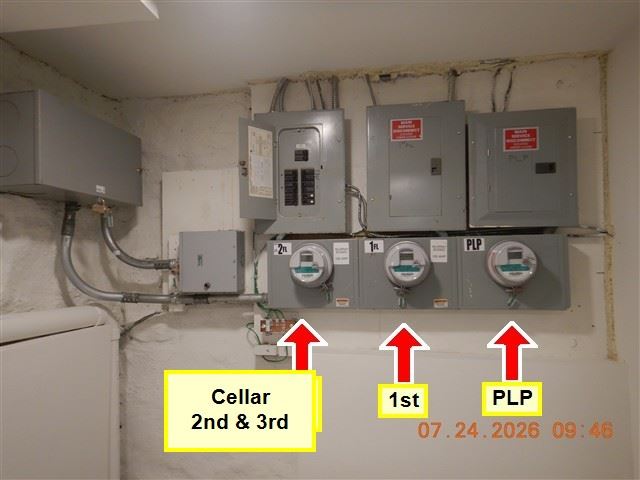
A bank of electric meters and disconnects on a wall, labelled in the report for cellar, first floor and the landlord supply.
A meter bank in a multi-family, labelled in the report so you know which meter feeds which apartment. Nobody remembers this at closing.

Lou takes the cover off the panel. That sounds obvious and it is not universal, and nothing meaningful about a panel can be established with it on. He reports what the wiring is, what condition it is in where it can be seen, and what has been done to it since.

What he cannot do is see inside a finished wall. If knob and tube is visible in the attic and the cellar, it is reasonable to assume it runs between them, but how much survives and where it was spliced is not knowable without opening things up. He will tell you that plainly rather than guess, and where an electrician needs to price it he will say so.

What it means for the purchase

Not automatic disaster. Most of these houses are still standing and most of this wiring has not burned anything down. But it is the kind of finding that costs real money to resolve and takes time to arrange, and both of those are worth knowing before your contingency runs out rather than after.

The practical squeeze is usually insurance rather than safety. Carriers decline, surcharge, or write the policy on condition the wiring is replaced inside a set period, and a lender can make that a condition of closing. Call your insurer before you are under contract, tell them what the house has, and get the answer while you still have room to negotiate.

Replacement is not always all-or-nothing either. Sometimes it is the attic runs and the panel; sometimes it is the whole house. That is an electrician’s number, not an inspector’s, and Lou takes nothing for pointing you at one. New York forbids him being paid for that referral.

Older housing is most of his work: pre-war Garden City and Rockville Centre, Brooklyn brownstones and the older north shore are exactly where this wiring lives.

Short answers

Was Federal Pacific recalled?

No. The CPSC closed its investigation in 1983 without a recall, citing insufficient data and budget. Independent testing has since found breakers that fail to trip. No recall means nobody will ever be made to replace one.

Is knob and tube dangerous?

Not inherently. It was designed to shed heat into open air. The danger is what came later: insulation buried over it, which the code prohibits at 394.12, plus amateur splices, missing grounds and oversized fuses.

Will insurance cover it?

Often not without conditions. Carriers decline, surcharge or demand replacement on a deadline, and a lender may make it a condition of closing. Ask your insurer before you are under contract.

Call Lou Text