Buying in Saddle Rock Estates: the questions with sourced answers
Each answer below cites where it comes from — the Census, the office that holds the permits, the state code, or Lou’s own reports.
How old are the houses in Saddle Rock Estates?
The Census puts the median year built for homes in zip code 11021 at 1955, and about 26% of the 8,705 housing units there were built before 1940. An older house is not a worse house, but its wiring, plumbing and roof were installed under different rules and replaced piecemeal, which is exactly what the inspection looks for. Source: U.S. Census Bureau, American Community Survey 2019–2023 5-year estimates, tables B25035 and B25034, ZCTA 11021.
What kind of housing is Saddle Rock Estates: single-family, two-family or apartments?
Of 8,705 housing units in zip 11021, about 32% are detached single-family houses, 2% are two-unit buildings, and 68% of occupied homes are owner-occupied. A two-family or a co-op is a different inspection from a detached house: shared systems, common areas and what the board or the other unit controls. Source: U.S. Census Bureau, ACS 2019–2023 5-year, tables B25024 and B25003, ZCTA 11021.
Who holds the building permits and certificate of occupancy for a house in Saddle Rock Estates?
Town of North Hempstead Department of Building, Safety, Inspection & Enforcement. Permits and COs are kept by the municipality, not the inspector; checking them is a records search, usually through your attorney. The inspection reports the condition of what is there and flags work that typically needs a permit — a finished basement, a dormer, a moved panel — so you know what to ask about. Town of North Hempstead Department of Building, Safety, Inspection & Enforcement. Unincorporated community (hamlet) per Nassau County List of Communities. Unincorporated; not the Village of Saddle Rock, which is a separate village with its own building department.
Which building code applies in Saddle Rock Estates?
Nassau County homes are built and inspected under the New York State Uniform Fire Prevention and Building Code (19 NYCRR), which applies in every part of the State except New York City and is enforced by each town, village or city building department. Source: dos.ny.gov.
Public water and sewer, or well and cesspool, in Saddle Rock Estates?
Nassau County gets all of its drinking water from groundwater beneath Long Island (mainly the Magothy aquifer); it is delivered by 46 public water systems (village, town and special-district suppliers), and there are only about 500 private wells. The Nassau County Department of Health tests public systems alongside the suppliers. Most of the county is sewered: the Nassau County Department of Public Works runs the Bay Park Sewage Treatment Plant, the Cedar Creek Water Pollution Control Plant and 37 pumping stations. Where public sewers exist a property must connect and abandon its cesspool, leaching pool or septic tank under DPW and Health Department guidelines; remaining on-site systems (largely the North Shore) fall under the Health Department's Division of Environmental Health. The inspection reports what the house actually has and its visible condition; a cesspool or septic system needs its own evaluation. Source: www.nassaucountyny.gov.
Is Saddle Rock Estates in a flood zone?
Flood zones follow the address, not the town. FEMA's OpenFEMA database holds 51,523 NFIP flood-insurance claim records for Nassau County (FIPS 36059), the most of any of the nine downstate counties. Look the address up on FEMA’s Flood Map Service Center before you sign. Source: www.fema.gov.
Should I test for radon in Saddle Rock Estates?
Nassau County is in EPA Zone 3 (low potential) — Zone 3 counties have a predicted average indoor radon screening level below 2 pCi/L. EPA still says every home should be tested regardless of zone. NYSDOH's county estimate (Feb 2007, 590 homes measured) is 0.3% of living areas and 4% of basements above 4 pCi/L; Oyster Bay town and Glen Cove city basements were about 8%. Radon is a separate, optional test arranged alongside the inspection. Source: www.epa.gov.
Is there a local rule in Nassau County a buyer should know about?
Under Article XI of the Nassau County Public Health Ordinance the County Health Department regulates oil and chemical storage; it runs a Small Heating Oil Tank Closure program for residential tanks under 1,100 gallons, and removal or abandonment of a home heating-oil tank is scheduled and confirmed through the Health Department's online portal (Office of Toxic & Hazardous Material Regulation, 516-227-9691). Source: www.nassaucountyny.gov.
Anything else specific to Nassau County?
In sewered areas every property must be connected to the public sewer, and old cesspools, leaching pools and septic tanks must be properly abandoned (Health Department Sewer Connections/Closures 516-227-9672). Source: archive.nassaucountyny.gov.
What did Lou’s Saddle Rock Estates inspection actually turn up?
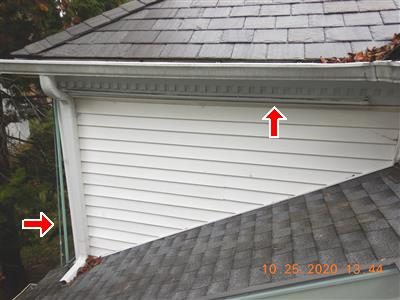
Across his report in Saddle Rock Estates, the summary listed 14 repair-or-replace items, most of them under the roof, chimney and attic, structural components and the kitchen. Every one is in the written report with a photograph; see what a report looks like.
How much does a home inspection in Saddle Rock Estates cost, and how fast is the report?
Lou quotes the actual property, not a flat rate — what drives the price is size, age and what is included. The written report arrives the same day as a rule; a large or complex house can run to the next morning. Call or text 516-330-3870.