What a home inspection costs in New York — and what moves the number
Lou Rubino has been inspecting houses on Long Island since 2010, and the first question is always the price. Most inspectors answer with a range that turns out not to apply to your house. Here is what is actually being priced, so that when you get a number — from him or from anyone else — you can tell whether it is a serious one.
Rather just have the number? Six answers about the house and Lou will quote it, usually the same day. Asking costs nothing — the quote is free and nothing is booked until you say so.
332 reviews on Angi across sixteen years and 88 on Google as of August 2026, five of them in the last six months. 5.0 on both. Licensed in New York since 2010.
The house sets the time, and the time sets the fee
An inspection is a person walking a building for two to four hours and writing it up, so most of what moves the price moves that time. A 1,100 square foot post-war ranch with one heating zone is not the same job as a 2,900 square foot 1910 colonial with a converted attic, two kitchens and a crawlspace you enter on your stomach. Quote without asking about the house and you are quoting the average — which is wrong for most houses, in both directions.
What other people are paying
A Spring 2026 survey collected 54 quotes for one specific house — roughly 1,800 square feet, built in the 1950s, in Nassau County, each inspector asked to include a wood-destroying insect inspection. The middle half of those quotes came in between $550 and $700, with a median of $643. The full spread ran from $450 to $960.
That is market research, not a price list, and it is worth knowing what it does not cover. It measured one house in one county. It says nothing about Queens, Brooklyn, Westchester or Staten Island, nothing about a larger house, and nothing about the century-old houses that are most of Lou's work — a house fifty years older than the one surveyed is a longer job, for the reasons below.
Asking what yours would cost is free. Lou gives you the number on the phone, before anything is booked and with nothing owed. That is the only way to get a figure that is actually about your house.
The six things that decide it
Square footage
The closest proxy for how long the walk takes, so it moves the number more than anything else here — though not linearly; twice the house is not twice the time.
The year it was built
An older house carries more eras of work. Knob-and-tube spliced into BX spliced into Romex; galvanized supply meeting copper meeting PEX; three roofs stacked on one deck. Each transition is a place to look carefully and a paragraph to write. Century-old houses are the bulk of what Lou inspects, and they take longer than new construction does.
How many systems there are
Not how many rooms — how many of the things that get tested. Two heating zones, a second kitchen, a finished basement with its own bath, a detached garage with power run to it. A two-family is meaningfully more work than a single-family of identical size.

Whether it can be reached
New York requires the report to state how the roof was observed (19 NYCRR 197-5) — which means an inspector who only looked from the ground has to say so. Lou walks it where it is safe and flies a drone where it is not: steep pitch, slate, wet weather, three storeys. Below ground the same rule applies. A crawlspace with a clear hatch gets inspected; one packed to the joists gets reported as inaccessible, and those are not the same job.
What is being tested beyond the standard inspection
The standard inspection already includes the thermal scan — that is not an upsell here.
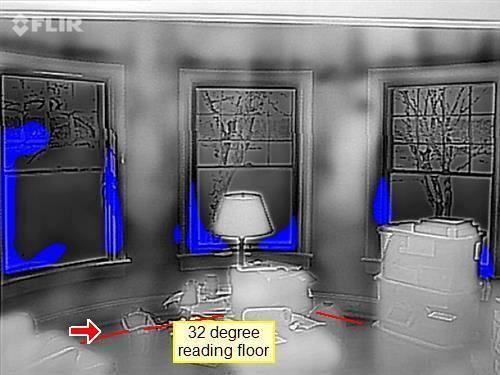
Septic, well water and radon are separate work with their own lab and equipment costs, so they are priced separately because not every house needs them.
Mold and asbestos are a different matter. New York requires a Mold Assessor licence to assess mold conditions (Labor Law Article 32), and an asbestos inspector certificate to collect bulk samples for a lab (12 NYCRR 56). Lou holds neither, so that work goes to a specialist who does — and it is quoted by them, not by him. An inspector who offers to do it himself without those credentials is telling you something useful about how he works.
How far it is
Lou covers Nassau, Suffolk, Queens, Brooklyn, the Bronx, Manhattan, Westchester and Staten Island. A job at the far edge of that carries travel that a job ten minutes from Wantagh does not.
What can change it on the day
The part most pricing pages leave out, and the part that produces the arguments afterwards. Lou raises these before the day, not on it:
- The utilities are off. A furnace that cannot be started is not inspected, it is noted as not inspected — and coming back is a second visit.
- Access is blocked. An attic hatch under boxes, a panel behind a bookcase. What cannot be reached is written up as not observed, which is worth less to you than what you paid for.
- The house is not what was described. An extra kitchen, a basement apartment, a converted garage — scope that changes on arrival rather than at quoting time.
- Weather covering what matters. Snow on a roof and standing water in a yard both hide exactly the things worth seeing.
None of these are surprises if they are raised before the day, which is why the quote asks about them.
Short answers
Why do home inspectors not publish a flat price?
Because the house sets the time, and time sets the fee. A 1,100 square foot post-war ranch with one heating zone and a 2,900 square foot 1910 colonial with a converted attic, two kitchens and a crawlspace are not the same job. An inspector quoting without asking about the house is quoting the average, and the average is wrong for most houses.
What information does an inspector need to quote a New York home inspection?
The address, the approximate square footage, the year built, how many kitchens and heating systems it has, whether it is a single family, a two family or a co-op, and whether the utilities will be on. Those six answers are enough for a firm number.
What can change the cost of a home inspection on the day?
Utilities shut off, so systems cannot be tested and a second visit is needed. Attic hatches, crawlspaces or electrical panels blocked by stored belongings. A house that turns out to have an extra kitchen or a converted unit nobody mentioned. Snow or standing water covering what needs to be seen.
Before the visit: the buyer's checklist lists what to have ready and what to ask the seller; selling, the seller's version lists the access to give and the cheap fixes that appear in almost every report.
Worth stating plainly: a home inspection in New York is a visual assessment of what is accessible on the day, under 19 NYCRR 197. It is not an appraisal, not a code compliance inspection, and not a guarantee against future failure. Anyone pricing it as though it were is selling something else.
Rated 5 out of 5
Enough detail to renegotiate the deal
“His feedback provided me the information I needed to re-negotiate my deal and budget for impending fixes… Lou made me feel very comfortable asking questions about things I didn’t understand.”
Rated 5 out of 5
A lead service line the owners didn’t know about
“Alerted me to a lead service line that the previous owners must not have known about. I don’t think there is a better home inspector out there.”
Rated 5 out of 5
Boilers and drainage, explained to new owners
“He was incredibly thorough and patient, explaining all the things that we, as first time homeowners, need to know about the minutiae of boilers and drainage.”
Or read a real inspection report before you decide.
Tell him about the house, get a number for that house
Not a range off a price list, and not a charge for asking. The quote is free. Lou has been licensed in New York since 2010 — licence 16000039568 — and he prices the job in front of him.
Buying an apartment? Manhattan co-ops and condos are quoted individually. Selling instead? A pre-listing inspection finds it before the buyer's inspector does.
Two discounts: twenty-five dollars off for seniors and twenty-five dollars off for veterans. One per inspection, and they cannot be combined. Mention it when you call and it is applied to the quote.
5.0 on Google and on Angi · 420 reviews between them · NY licence 16000039568 since 2010 · InterNACHI 09120509