Under contract and on a clock? Call 516-330-3870 Text Email

Inspect This Home Inspections Army Veteran Owned · NY Licensed
Brooklyn · the brownstone belt

Home inspector in Park Slope, NY

Between 2017 and 2026, Lou Rubino inspected 20 homes in Park Slope. The Slope's brownstones went up mostly between the 1880s and the 1910s, and buying one means buying a hundred-plus years of decisions — original, Victorian-era craftsmanship and every owner's project since, stacked four storeys high.

Rated 5.0 on Google as of August 2026 · U.S. Army veteran owned · NY licence #16000039568 · 516-330-3870

A brownstone is read at its top and bottom

The cellar is the honest end of the house. Down there the original joists, the notches and patches of every plumbing era, and the beams that have carried it all along are simply visible — nothing has been decorated. Lou spends real time in Park Slope cellars because the floors above only make sense once you have seen what holds them.

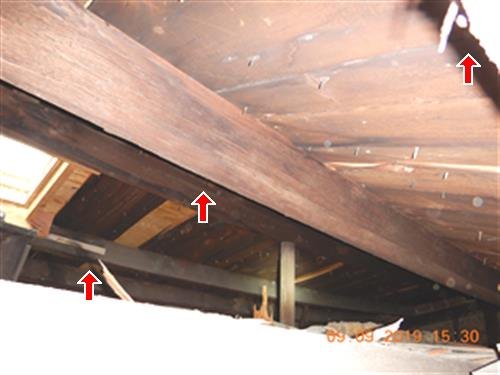
The top floor is the other truth-teller. Under the roof, the rafters record every leak the ceilings have long since been painted over — and with a curb-invisible flat or shallow-pitch roof above, that record is usually the only warning you get. A finished top floor with no attic access is precisely the "not observed, and here is why" case New York requires the report to spell out.

Related: How Lou inspects a brownstone · What an inspection costs · Schedule an inspection.
Photographs from Park Slope reports

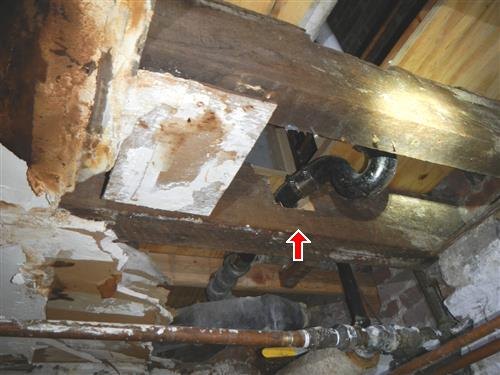
Old wood cellar joists with historic notches, patches and plumbing penetrations, one point arrowed.
Cellar joists in a Park Slope brownstone: a century of notches, patches and re-plumbed runs, one finding arrowed. Nothing down here is decorated, which is why it is honest.
The underside of roof rafters and boards on a top floor, with staining marked by red arrows.
Roof rafters on a Park Slope top floor, water marks arrowed — the ceilings below were repainted; the rafters were not.
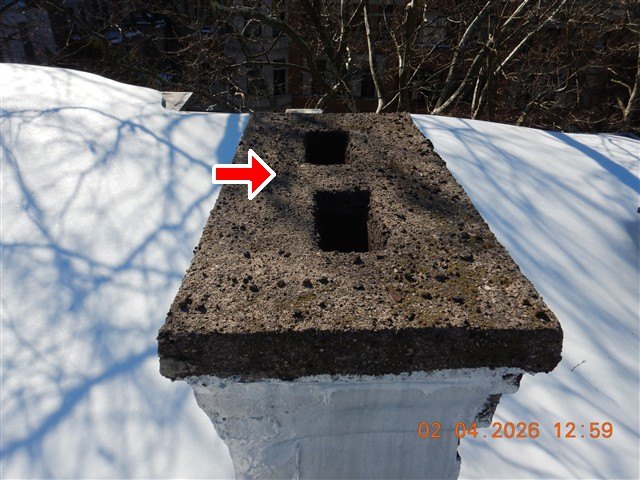
A masonry chimney crown with two open square flues, photographed in winter light, one arrow marking the crown.
A Park Slope chimney crown with two open flues — four storeys of chimney, read from the top.

All three photographs are from Lou's own Park Slope inspection reports, chosen because they show a building component and nothing that identifies a property or an owner.

From the Park Slope files

More of what Lou has actually photographed and flagged on Park Slope inspections. Open any note to learn what the finding means for a buyer — every link stays on this site.

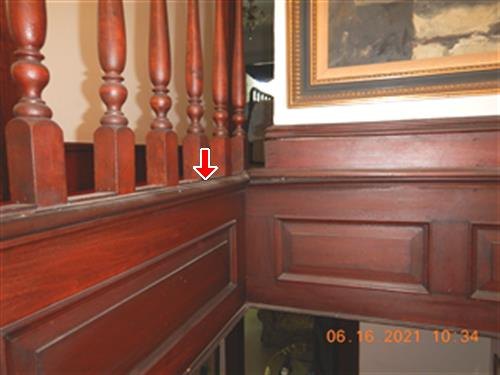
Dark wood stair balustrade and raised paneling with a red arrow at the top rail
The red arrow marks the top rail of a wooden stair balustrade where two sections meet. Railings are tested by hand during inspection to confirm they are secure, since a loose rail on a stair is a fall hazard.
What this means: interior evidence

Interior finishes are read as evidence, not decoration — a crack pattern, a stain edge or a new patch of paint each say something about what the building has been doing. See how findings are documented.

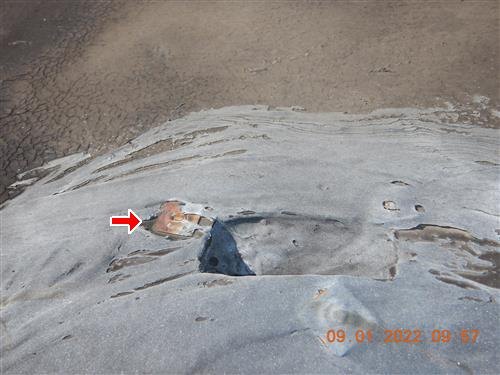
Silver-coated flat roof with red arrow at a raised patched area with exposed dark membrane
The red arrow marks a raised, patched spot on a silver-coated flat roof where the coating is broken and dark membrane shows through. Flat roofs are examined for blisters and failed patches because ponding water finds these weak points first.
What this means: the flat roof

A flat roof hides everything from the street: membrane seams, patches, drainage and parapet condition. Patching is normal maintenance — the question a report answers is whether the membrane still has a working life. How roofs are examined and reported.

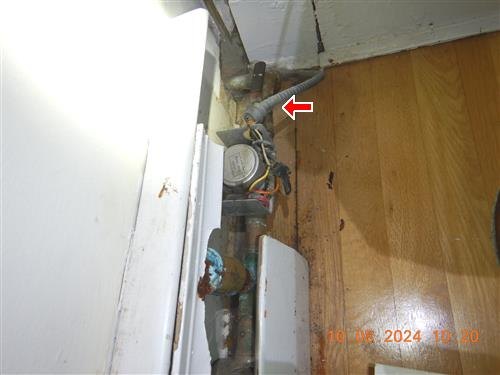
Water meter and corroded piping in a floor opening beside a cabinet, red arrow on a connector
The red arrow marks a connector at the water meter, where the surrounding piping shows heavy corrosion and mineral deposits. Corroded fittings at the meter are a common source of slow leaks and are checked closely.
What this means: supply plumbing

Supply plumbing is judged by material and era — and by the small evidence at the joints. Corrosion and mineral tracks at connections show slow weeping long before a failure. Moisture evidence, explained.

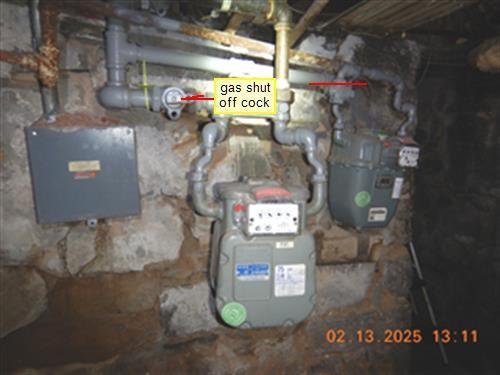
Two gas meters on a stone cellar wall, yellow label and arrows marking the gas shut off cock
The label and arrows identify the gas shut-off cock on the piping above these cellar gas meters. Knowing where this valve is lets an owner stop the gas quickly in an emergency.
What this means: the gas service

Meters, regulators and gas piping are checked visually and, where warranted, with instruments — outdoor equipment in salt air earns a closer look. How a building is metered is also part of what you are buying. The licence behind the inspection.

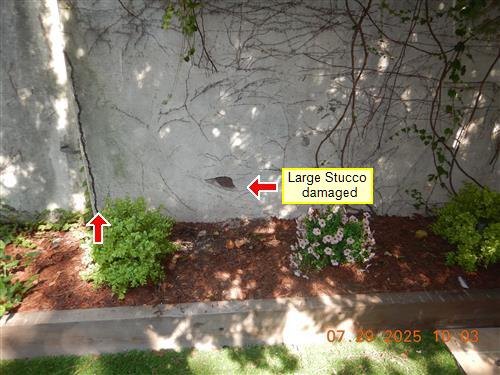
Stucco wall above a planting bed with a hole and crack, labeled large stucco damaged
The arrows mark a hole in the stucco and a vertical crack near the edge of this wall. Openings in stucco let water get behind the finish, which breaks away more material over time.
What this means: the exterior envelope

Siding, trim, masonry and parged walls are the building's raincoat, and cracks or failed mortar can give water a way in. The report documents their location and pattern so the right contractor or specialist can evaluate them when warranted. Where water gets in, explained.

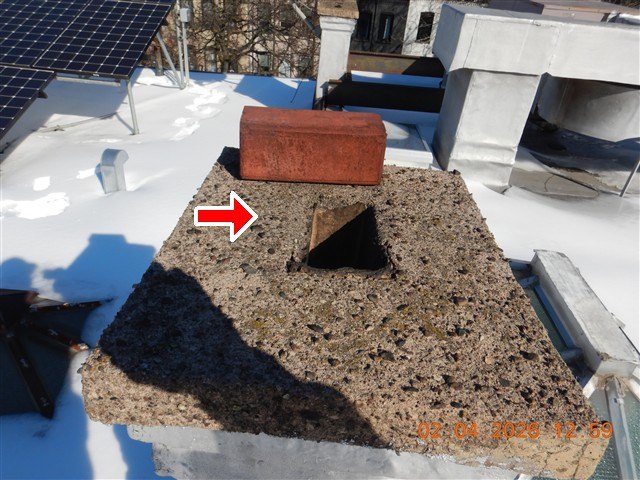
Rooftop chimney cap with an open flue hole and a loose brick on top, red arrow, snow around
The red arrow marks an open, damaged flue opening in this rooftop chimney cap, with a loose brick resting on top. An unsealed flue lets rain and animals straight down into the chimney.
What this means: the chimney

Chimney crowns, caps and screens are the cheap parts that protect the expensive parts. Cracked crowns and missing screens let water and animals into a flue, and the damage below can run for years unseen. What happens when part of a system cannot be seen.

All photographs are from Lou's own inspection reports for jobs in this area, screened so nothing identifies a property or an owner.

Approximate town-centre locator — Park Slope in red, Lou’s Wantagh base in navy. Not a job location, an office, or a service boundary.

Where this sits in Lou's territory

Lou covers Long Island, the five boroughs and Westchester from his base in Wantagh, and the archive behind these pages shows where that work has actually concentrated.

Also nearby: Prospect Heights · Prospect Lefferts Gardens · all 26 towns.

Call Lou Text