Under contract and on a clock? Call 516-330-3870 Text Email

Inspect This Home Inspections Army Veteran Owned · NY Licensed
Brooklyn · frame rows under vinyl

Home inspector in Bushwick, NY

Between 2013 and 2022, Lou Rubino inspected 10 homes in Bushwick. Much of Bushwick is older than it looks: nineteenth-century wood-frame rowhouses that were wrapped in vinyl, aluminum or stucco decades ago. The skin is from the 1970s; the house underneath can predate the light bulb — and the inspection has to be about the house.

Rated 5.0 on Google as of August 2026 · U.S. Army veteran owned · NY licence #16000039568 · 516-330-3870

Siding hides age; the roof and rear reveal it

Modern siding is not a defect, but it ends the conversation the facade used to have with you — you can no longer see the frame move, the sills rot or the water stain. So the evidence moves to where the wrapping stops: the flat roof, the parapets, the rear walls. That is where Lou reads a Bushwick house's real age and real condition.

Up top, these roofs carry generations of coatings and patches over the original structure. Patching is honest maintenance — the question the report answers is whether the membrane still has a working life or the patches have become the roof.

Related: Brooklyn rowhouses, explained · What an inspection costs · Schedule an inspection.
What the inspection can examine here

  • The roof and rear walls — on a wrapped frame house, the unwrapped surfaces carry the evidence.
  • The frame's movement — read at openings, corners and the rear elevation.
  • Coatings and patches, dated — when the patches become the roof, the report says so.
  • Old-house systems — wiring that can predate the light bulb's second generation.

Photographs from Bushwick reports

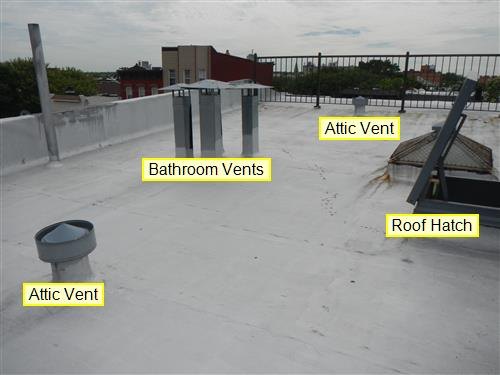
A white-coated flat roof with attic vents, bathroom vents and the roof hatch labelled.
A Bushwick flat roof with its features labelled for the report — on a wrapped frame house, this is where the building's condition is legible.
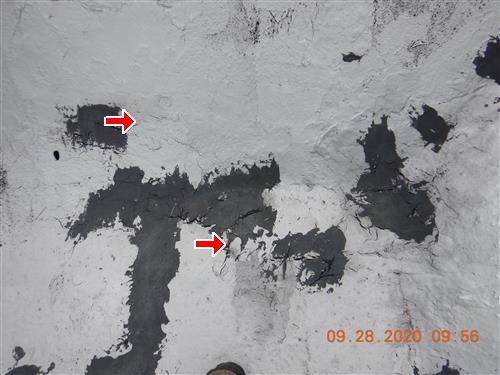
A silver-coated flat roof surface with multiple dark patched areas marked by red arrows.
Patch over patch on a coated Bushwick roof, arrowed. At some point the patches become the roof; the report says whether that point has passed.
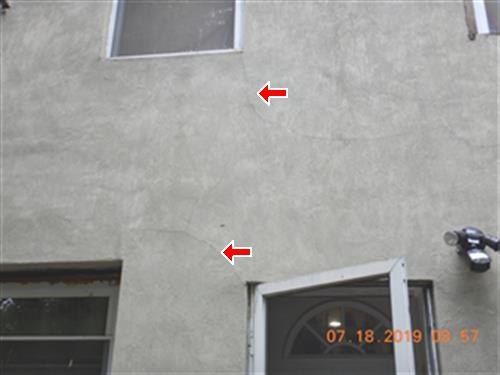
A stucco-parged rear wall with two cracks marked by red arrows beside window openings.
Cracks arrowed in the parged rear wall of a Bushwick frame house — the rear elevation says what the vinyl front cannot.

All three photographs are from Lou's own Bushwick inspection reports, chosen because they show a building component and nothing that identifies a property or an owner.

From the Bushwick files

More of what Lou has actually photographed and flagged on Bushwick inspections. Open any note to learn what the finding means for a buyer — every link stays on this site.

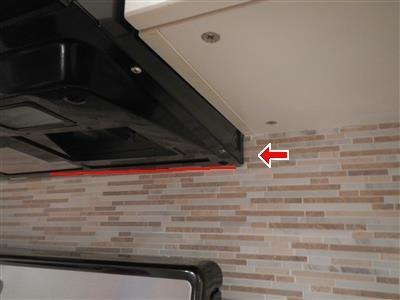
Underside of a black range hood above a tiled backsplash, with a red line and arrow markup.
The inspector's red markup traces the junction between the range hood and the wall behind it, with the arrow at the rear corner. Gaps or loose mounting here are noted because a hood must be securely fixed and sealed to vent cooking exhaust properly.
What this means: interior evidence

Interior finishes are read as evidence, not decoration — a crack pattern, a stain edge or a new patch of paint each say something about what the building has been doing. See how findings are documented.

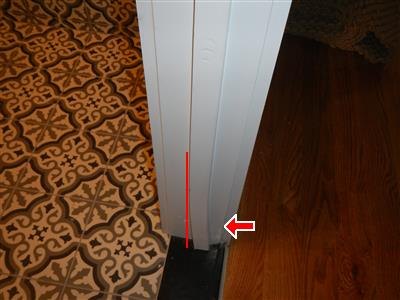
White door casing with a red vertical line and arrow at its base, between tile and wood floors.
A red line traces a seam opening in this painted door casing, and the arrow points to its base at the saddle between two floor finishes. Separations like this are recorded so a buyer knows to watch whether the gap stays stable or keeps moving.
What this means: interior evidence

Interior finishes are read as evidence, not decoration — a crack pattern, a stain edge or a new patch of paint each say something about what the building has been doing. See how findings are documented.

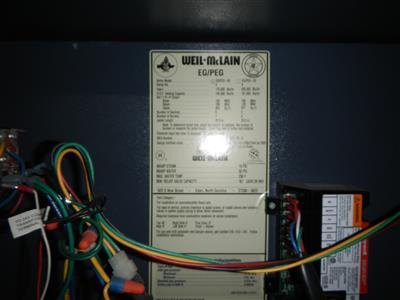
Weil-McLain boiler data plate with control wiring harness in front.
The manufacturer's data plate on a gas boiler lists its model, input rating, and capacity. Inspectors photograph these plates to establish the equipment's age and size, which helps estimate remaining service life.
What this means: the heating plant

A boiler's data plate gives its real age; the burn chamber and the piping around it give its real condition. Both go in the report so replacement budgeting is arithmetic, not argument. What an inspection costs against what it finds.

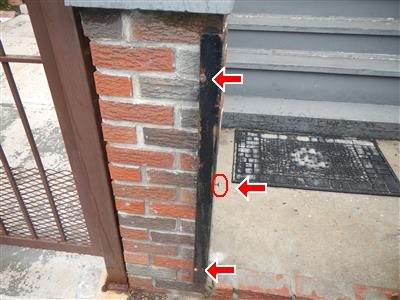
Rusted black steel post set into a brick pier, with three red arrows and a circled hole.
Red arrows mark rust along a steel support post where it is embedded in brick at an entry, and the circle flags a hole rusted through the metal. Steel that loses section to rust loses strength, so its condition is documented for repair.
What this means: the structure

Cracks are information: their direction, width and pattern say whether masonry has settled and stopped or is still moving. The report traces them so a later reader can see change. What a condition report does and does not rule on.

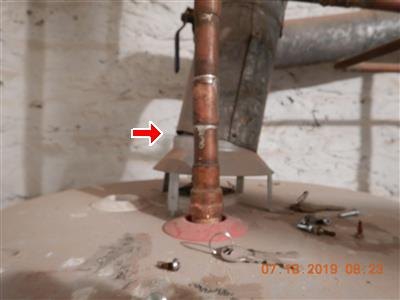
Copper pipe rising from a water heater top, red arrow at a soldered joint, orange date stamp.
The arrow points to a soldered joint on the copper water line above a water heater, where mineral deposits are visible at the fittings. Deposits like this can indicate past or slow seepage at a joint, which is checked before it becomes an active leak.
What this means: the water heater

Water heaters have a known service life, and their installation — clearance, venting, the gas connection, the pan — matters as much as their age. All of it is checked where it sits. What the write-up looks like.

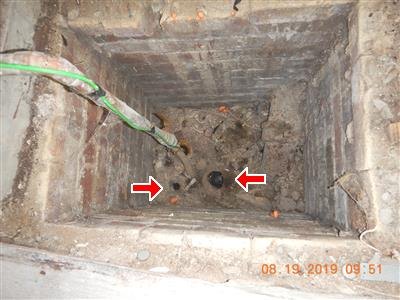
Brick-lined pit below a floor with drain piping and two red arrows, orange date stamp.
This masonry access pit contains the building's below-floor drain piping, with arrows marking the trap fittings. Inspectors open these pits because the condition of the house trap and its plugs affects how sewer gases and blockages are controlled.
What this means: the drains

Drains are judged where they are visible — traps, materials, slopes and improvised repairs. An improper fitting works right up until it does not, which is why it belongs in the report while it is still cheap. See how findings are written up in a real report.

All photographs are from Lou's own inspection reports for jobs in this area, screened so nothing identifies a property or an owner.

Approximate town-centre locator — Bushwick in red, Lou’s Wantagh base in navy. Not a job location, an office, or a service boundary.

Where this sits in Lou's territory

Lou covers Long Island, the five boroughs and Westchester from his base in Wantagh, and the archive behind these pages shows where that work has actually concentrated.

Also nearby: Bedford-Stuyvesant · Greenpoint · all 26 towns.

Call Lou Text